Position Paper on the Role of Social Workin Specialist Palliative Care in Ireland
This position paper highlights the essential role social workers in SPC play in addressing the complex needs of patients and their families within adult palliative care services, which Tzvetanova (2024) notes as some of life’s most challenging moments. It identifies key opportunities for development, to strengthen service delivery and meet the growing demands of an aging and increasingly diverse population.
Guidance for Bereavement Support
In this document we outline the bereavement support needs of patients and their families as part of a continuum of care from illness into bereavement. We review current understandings of the grief and loss experience in the context of research, guidance and policy. This informs the evidence-based guidance for social workers in their support of patients and their families within specialist palliative care services.
APPM Clinical Guidelines (2023) – Seizures, agitation and GI dystonia
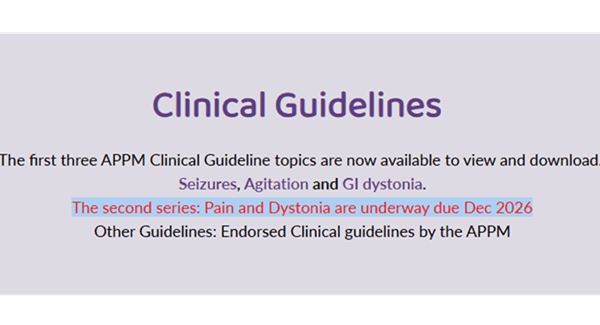
The APPM clinical guidelines seek to address symptoms, topic by topic, offering robust evidence-based, peer-reviewd clinical guidance to clinicians working with children and their families to support symptom management, palliatve and end of life care. The APPM members prioritised the symptoms in need of roubust guidance: Seizures, Agitation and GI Dystonia (initally called ‘gut failure’)
Association for Paediatric Palliative MedicineFormulary 2024 (6th edition)

The APPM’s entire formulary has been reviewed and updated incorporating recent published literature, specialist advice and feedback from formulary users. Many of the monographs have been extensively rewritten and references have been brought up to date. The formulary has also been completely reformatted, including greater use of tables and with the aim of improving clarity and navigability.
Together for Short Lives Series of Care Pathways

The Together for Short Lives Series of Care Pathways focus on putting children and families at the centre of the process of planning care and support, with the aim of delivering integrated services in response to individual needs. The Together for Short Lives pathways aim to provide broad frameworks for developing more detailed and bespoke local pathways.
Guidance for Bereavement Support provided bySpecialist Palliative Care Social Workers
Hospice & Palliative Care Social Workers Group guidance on bereavement support needs of patients and their families as part of a continuum of care from illness into bereavement. The document reviews the current understandings of the grief and loss experience in the context of research, guidance and policy. This informs the evidence-based guidance for social workers in their support of patients and their families within specialist palliative care services.
Compassion and Pride for the LGBTQIA+ Community in Death
Ember is an end-of-life guide that was developed and driven by a group of volunteers from the LGBTQIA+ community and allies. It aims to inform and empower LGBTQIA+ people to start thinking about Advance or Future Care Planning for end of life and support Health and Social Care professionals caring for the community at end of life.
IAHPC Manual on the Use of Essential Palliative Care Medicines for Adults.
This Manual provides practical recommendations for the safe and effective use of the medications for palliative care included in the WHO EML and in the Lancet Commission Report. The Manual is intended to support health professionals who are not specialists in palliative care — doctors and others providing generalist or primary palliative care
Talking about sex, sexuality and relationships: Guidance and Standards

Together for Short Lives guidelines and standards ‘Talking about sex, sexuality and relationships’ aims to provide some key standards for health, social care and education staff working with young people who have life-limiting or life-threatening conditions (LLTCs).
It provides information about how best to support young people, and their families, in addressing sexuality, sexuality expression, relationships and intimacy, providing signposts to useful resources and examples of the law applied to practice. It is not a comprehensive ‘how to’ guide covering every aspect of sex, intimacy and relationships but aims to highlight some of the key issues that may arise and build confidence in how to approach the issue of sexuality with young people.
Palliative and End-of-Life Care at the Deep End: Trauma-informed and inclusive approaches to palliative and end-of-life care for people experiencing marginalisation.

Shaun Peter Qureshi, Churchill Fellow 2023, has published a report representing the results of his Churchill Fellowship research exploring overcoming the problem of inequity in palliative and end-of-life care access in the UK. This report is the culmination of international learning and discovery which has led to the development of ten recommendations for inclusive trauma-informed palliative care. The report focuses in detail on the needs of people who are in prison and people experiencing homelessness (encompassing all forms of homelessness and being vulnerably housed)