
Global Atlas of Palliative Care
The Global Atlas of Palliative Care (2020) is a source of essential information on the status of palliative care worldwide. This second edition of the Global Atlas reveals some of the changes that have occurred since the first edition was published in 2014. For instance, we now have a better idea of how many people need palliative care worldwide. The Atlas is published by the World Hospice Palliative Care Alliance
Irish Hospice Foundation
Every death matters and we only have one chance to get it right. The Irish Hospice Foundation work to ensure the best end-of-life and bereavement care, for all. From advocacy and education, to vital services like Nurses for Night Care, IHF’s Bereavement Support Line, and Information and Support Line, the IHF believe in the importance of dying well and grieving well wherever the place. the website includes a large number of resources for professionals working in the area
Irish Association for Palliative Care
The Irish Association for Palliative Care (IAPC) is a Collective and Expert Voice for Palliative Care in Ireland. The support a number of forums and groups including the Nursing Forum, Pharmacy Forum, Ethics Forum and the Education and Research Forum
European Association for Palliative Care
The EAPC is a membership organisation of professionals committed to supporting the promotion and development of palliative care throughout Europe and beyond. EAPC members are united by our vision which aspires to see palliative care availability and accessibility, wherever and whenever it is needed. The EAPC website includes a large amount of information and resources for professionals including information on research projects, EAPC Groups (including Tasks Forces and Reference Groups)
Navigating Uncertainty in Palliative Care Practice Webinar recording
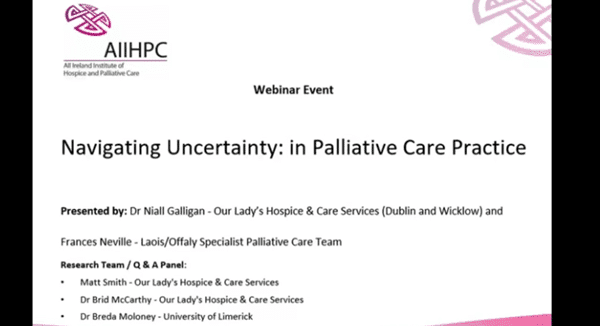
This webinar provided an up-to-date overview of the literature on uncertainty, as well as evidence-based, patient-centred strategies to help clinicians understand and navigate uncertainty more effectively in clinical practice.
Scottish Partnership for Palliative Care
The Scottish Partnership for Palliative Care brings together health and social care professionals from hospitals, social care services, primary care, hospices and other charities, to find ways of improving people’s experiences of declining health, death, dying and bereavement. Their website includes a wide range of resources including ones for health and social care professionals
AIIHPC Scoping Report – Access to palliative and end of life care for people with learning disability and people experiencing homelessness in Northern Ireland.

This scoping work, undertaken by AIIHPC, in partnership with the Public Health Agency and Palliative Care in Partnership, focuses on two groups who are often underserved within existing systems and structures: people with learning disability and people experiencing homelessness. Across Northern Ireland, there is growing recognition of the importance of equitable access to palliative and end of life care for all members of our communities. This includes recognising and responding to the experiences of people who may face additional barriers in accessing services, support and meaningful conversations about care, illness, dying and bereavement.
Positively Palliative: Stories of Care, Loss and Love Book (AIIHPC)
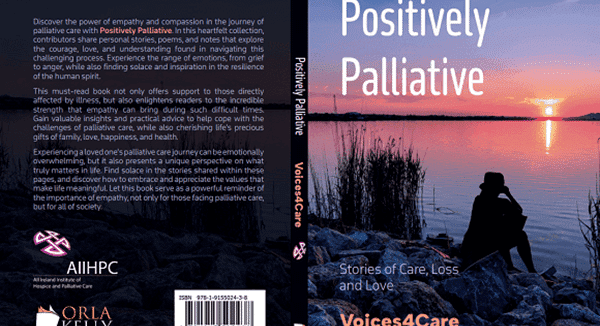
Positively Palliative: Stories of Care, Loss and Love Book (AIIHPC)
APPM Clinical Guidelines (2023) – Seizures, agitation and GI dystonia
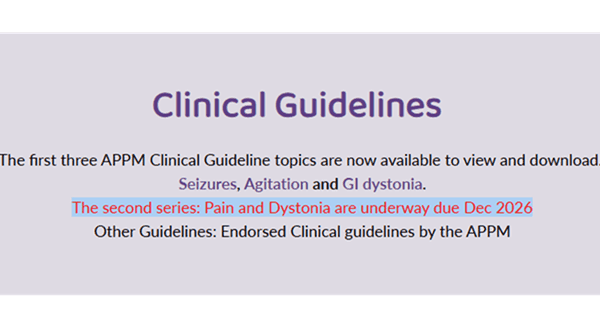
The APPM clinical guidelines seek to address symptoms, topic by topic, offering robust evidence-based, peer-reviewd clinical guidance to clinicians working with children and their families to support symptom management, palliatve and end of life care. The APPM members prioritised the symptoms in need of roubust guidance: Seizures, Agitation and GI Dystonia (initally called ‘gut failure’)
Association for Paediatric Palliative MedicineFormulary 2024 (6th edition)

The APPM’s entire formulary has been reviewed and updated incorporating recent published literature, specialist advice and feedback from formulary users. Many of the monographs have been extensively rewritten and references have been brought up to date. The formulary has also been completely reformatted, including greater use of tables and with the aim of improving clarity and navigability.